
Music Publishing 101: Understanding Your Songwriter Royalties
Mechanical royalties, performance royalties, sync fees: learn where your money comes from and how to make sure you're collecting all of it.
The short version
- Every song has two copyrights: the composition and the recording. Publishing money flows from the composition.
- Songwriters earn four royalty types: performance, mechanical, sync, and print.
- You can claim both writer and publisher shares through your PRO without a publishing company.
- A publishing administrator becomes valuable once your music earns internationally.
If there's one area of the music business that confuses independent artists more than any other, it's publishing. And that confusion has a real cost: billions of dollars in royalties go uncollected every year because artists don't understand what publishing is, what it does, or how to set it up.
This guide breaks it down in plain English. No jargon, no legalese. Just a clear explanation of how publishing works, why it matters, and what you need to do to start collecting every dollar you're owed.
The Two Copyrights in Every Song
This is the most important concept in music rights, and everything else flows from it. Every recorded song contains two separate copyrights:
- The composition: the melody, lyrics, and musical structure. This is the "song" as a piece of intellectual property, regardless of how it's recorded. This is the publishing side.
- The master recording: the actual recorded audio. The specific performance, production, and mix that you hear when you press play. This is the master side.
These two copyrights generate separate revenue streams, are often owned by different people, and are administered through different systems. When most people say "publishing," they're talking about copyright #1, the composition.
The Four Types of Songwriter Royalties
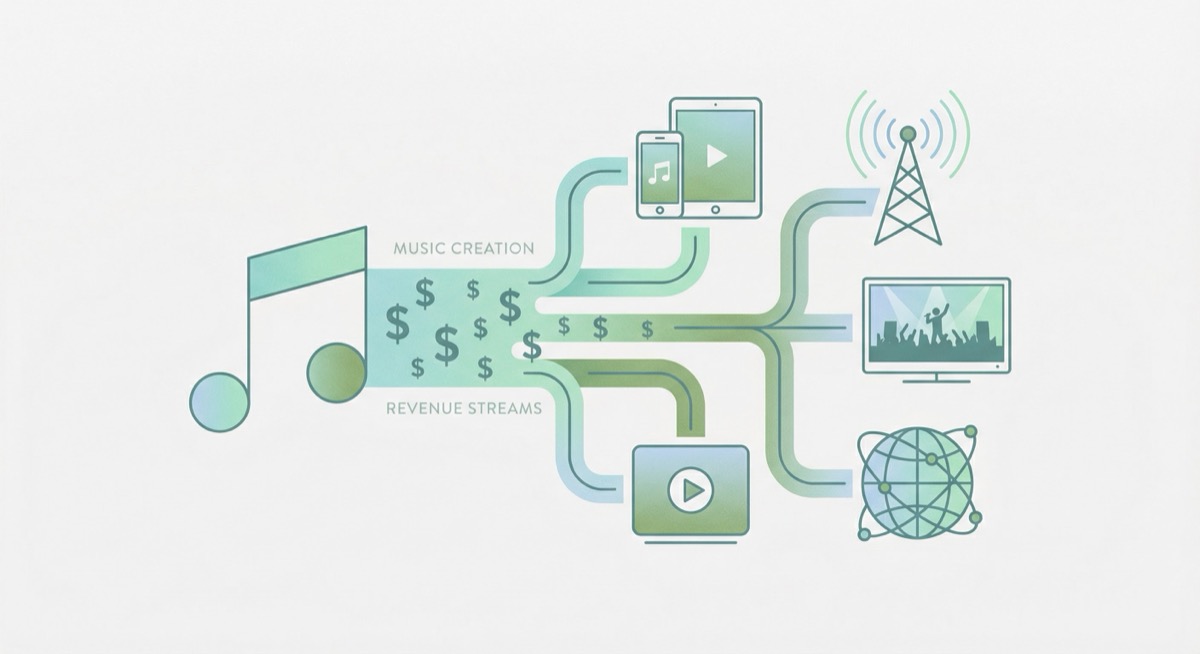
Your compositions generate revenue through four main channels. Understanding each one is critical to making sure nothing falls through the cracks.
1. Performance Royalties
Generated every time your song is performed publicly: radio airplay, streaming (Spotify, Apple Music), live performances, TV broadcasts, restaurants, bars, and anywhere else music is played for an audience. These are collected by your PRO (ASCAP, BMI, or SESAC).
Performance royalties are typically the largest royalty stream for songwriters. They're split into a writer's share (paid directly to you by the PRO) and a publisher's share (paid to your publisher, or to you if you self-publish).
2. Mechanical Royalties
Generated every time your song is reproduced: when someone streams it, downloads it, or presses it onto a physical CD or vinyl. In the US, mechanical royalties from streaming are collected by the Mechanical Licensing Collective (MLC), which was created by the Music Modernization Act in 2018.
Your PRO does not collect mechanical royalties. This is a separate registration and a separate income stream. Many independent artists miss this entirely.
3. Sync Licensing Fees
Generated when your composition is synchronized with visual media: TV shows, films, commercials, video games, YouTube videos, and podcasts. Sync fees are negotiated directly (or through a sync agent/publisher) and can range from a few hundred dollars to hundreds of thousands, depending on the placement.
We cover sync licensing in detail in our dedicated sync guide.
4. Print Royalties
Generated when your composition is printed as sheet music. This is a smaller revenue stream in 2026, but it still exists, particularly for compositions used in education, orchestral arrangements, and worship music.
What Does a Music Publisher Actually Do?
A publisher's job is to maximize the revenue from your compositions. In practice, that means:
- Registering your songs globally with PROs, mechanical collection agencies, and sub-publishers in every territory where your music might be played
- Collecting royalties from all sources worldwide, including countries where you'd never be able to track down payments on your own
- Pitching your music for sync placements in TV, film, and advertising
- Managing metadata to ensure your songs are properly identified across all platforms
- Protecting your copyrights and pursuing unauthorized uses
Do You Need a Publisher?
It depends on where you are in your career. Here's a practical breakdown:
Just Starting Out
You probably don't need a traditional publisher yet. Register with your PRO, claim both your writer and publisher shares, and focus on building your catalog. A publishing admin service like Songtrust ($100 setup + 15% commission) can handle global collection at a reasonable cost.
Growing Catalog with International Plays
Once your music is being played internationally, even through streaming, a publishing administrator becomes more valuable. They'll register your songs with collection agencies in 200+ countries and territories, catching royalties you'd otherwise miss entirely.
Established Career
At this stage, a full publishing deal might make sense. A traditional publisher offers advances, active pitching for sync and cover opportunities, and dedicated creative support. The tradeoff: they take a larger share (often 50% or more of your publishing income) and may acquire some or all of your copyright for a period of time.
Key insight: You don't have to give up any ownership to start collecting publishing royalties. Admin deals let you retain 100% of your copyright while getting professional collection infrastructure. It's the best option for most independent artists.
The Publishing Administration Checklist
Whether you self-publish or work with an admin service, here's what needs to happen for every song you release:
- Create a split sheet documenting all contributors and their ownership percentages (use SyncFlow for this)
- Register the song with your PRO (ASCAP, BMI, or SESAC) including all contributor IPI numbers
- Register with the MLC (themlc.com) to collect US mechanical royalties from streaming
- Register with a publishing admin if you want global collection (Songtrust, CD Baby Publishing, or TuneCore Publishing)
- Ensure your distributor has correct metadata: ISRCs, songwriter credits, and publisher information all need to match
Common Publishing Mistakes
- Not registering with the MLC. Your PRO collects performance royalties. The MLC collects mechanical royalties. They're separate. If you only register with one, you're missing an entire revenue stream.
- Inconsistent metadata. If your name is spelled differently across your PRO registration, distributor, and MLC account, royalties can get lost in the system.
- Waiting to register songs. Just like PRO registration, mechanical royalty collection starts from the date you register. Don't leave months of earnings on the table.
- Signing away rights without understanding. Some publishing deals are great. Others lock up your catalog for decades. Always understand what you're giving up before signing anything.
- Skipping split sheets. If ownership isn't clearly documented from day one, every other step in this process becomes harder. Split sheets are the foundation.
Frequently Asked Questions
What is the difference between the master and the composition?
The master is the specific recording; the composition is the underlying song, its melody and lyrics. Each has its own copyright and earns its own royalties. Publishing income flows from the composition side.
Can I be my own publisher?
Yes. Independent songwriters can register with their PRO as both writer and publisher and collect both shares. You do not need a separate publishing company to start collecting.
What does a publishing administrator cost?
Admin services typically charge a small setup fee plus a commission on collected royalties. Songtrust, for example, charges a $100 setup fee and a 15% commission while registering your songs with collection societies worldwide.
The Bottom Line
Publishing isn't as complicated as the industry makes it seem. At its core, it's about making sure your compositions are properly registered everywhere they could generate income, and making sure someone is collecting that income for you.
The most important step? Documentation. Every publishing workflow starts with knowing who owns what, and that starts with a split sheet. Get that right, and everything else falls into place.
Sources: Songtrust, Elizabeth Records, Vampr, ALERA
Put your next song on paper.
SyncFlow turns splits, signatures, and files into one organized record of who owns what. Cancel anytime.
Start your trial